
The oil in your pan used to be in your paint
Reading time: 3–4 min
You choose your oils carefully: cold-pressed, organic, first-press. You read the labels and invest in a dark glass bottle. And yet, that healthy oil might not be as healthy as you think once it’s in the pan. That’s because the quality of the fat depends not so much on where it comes from, but on what it can withstand: whether it remains intact or breaks down. There is one characteristic that determines whether oil nourishes you or, on the contrary, puts a strain on you, and that is the focus of this article: stability.
In this blog, the delve deeper into what testosterone is, why it drops, where pinepollen fits into this story and what research does (and does not) show.
I’m going to take you through a topic that’s surprisingly rarely discussed: what heating does to oil, and what that means for your body. After all, what good is the finest organic oil if it breaks down in your pan before it even reaches your plate?
Why Some Oils Can Withstand Heat and Others Cannot
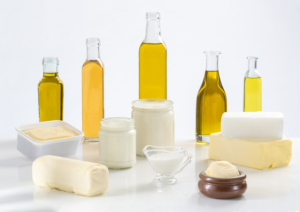
To understand what’s happening in your pan, it helps to imagine a fat molecule as a chain of links. In stable fats such as butter, ghee, coconut oil, and beef tallow, those links are firmly and tightly connected. They remain stable and can be heated without breaking down. With many vegetable oils, it’s different: their chains contain weaker spots that easily react with oxygen, heat, and light. And the more of these weak spots an oil has, the faster it breaks down when exposed to light and heat. Sunflower, soybean, corn, safflower, grapeseed, canola, rapeseed, flaxseed, and walnut oils belong to this more sensitive group.
That breakdown has a name: oxidation. You’re actually already familiar with the phenomenon. Cut an apple in half and leave it out, and you’ll see it slowly turn brown. That’s oxygen reacting with the exposed surface. Something similar happens in a hot pan, only much faster, and in the process, small, reactive molecules are formed that can cause damage to your cells. The rancid smell of old frying oil is the simplest proof of this: that is literally the smell of fat oxidizing. And what makes this so relevant to your daily health is that this process continues in the warm, oxygen-rich tissues of your body, even after you’ve eaten.
So the question isn’t whether a fat is “good” or “bad,” but whether it can withstand the conditions under which you use it.
How These Oils Ended Up in Almost Everything
What many people don’t know is that most vegetable oils weren’t originally considered food at all. Flaxseed oil, for example, wasn’t used in salads but in paint: it has traditionally been a base for oil paint and varnish, precisely because it oxidizes and hardens into a solid layer. We didn’t eat it; we used it to paint wood. And it is precisely that property that made flaxseed oil so suitable for painters—its eagerness to react with oxygen—that you’d rather not have in your pan or in your body.
Canola and rapeseed oils were formerly used as lamp oil and as lubricating oil for machines before they entered the food supply in the 1970s.
Saturated fats (butter, lard) fell out of favor, and vegetable oils were hailed as the healthy alternative. They were also very inexpensive. Since then, they’ve found their way into just about everything—potato chips, packet sauces, ready-made meals, and deep-fryers. As a result, the balance of the fats we consume has slowly become skewed. That’s a shame for our bodies, because they thrive on balance.
What this has to do with cholesterol
This is where it gets interesting, because this shift touches on one of the most persistent myths in nutrition science. For decades, we were told that we had to swap butter for vegetable oil to protect our hearts. Saturated fat was said to raise your cholesterol, cholesterol was said to clog your arteries, and that was that. It sounded logical, and it was repeated so often that almost no one questioned it anymore.
And to this day, that has remained the official line: cut back on saturated fat, and you’ll protect your heart. Yet there is a growing group of researchers who are turning that narrative on its head. Among the best-known voices is Ray Peat, and their reasoning goes like this: cholesterol is not the culprit we’ve been led to believe it is. According to them, cardiovascular disease begins with inflammation and damage to the blood vessel wall, and the cholesterol that doctors find at the site of that damage isn’t the cause—it’s actually a repair agent. A band-aid on the wound. You see firefighters at almost every fire, and yet no one would call them the arsonists.
And this is where the two stories converge. Because the fat that oxidizes so easily and can fuel inflammation—that same sensitive vegetable oil—is precisely the fat we were advised to consume to protect our hearts. If inflammation is indeed the real cause, then for decades we’ve been fueling the fire we were trying to put out.
According to this same research group, that’s not all. These oils are also said to slow down the thyroid gland—the gland that keeps your metabolism running at a steady pace—and thus contribute to symptoms that many people recognize but rarely associate with their cooking oil: fatigue, feeling cold, and a body that’s slow to get going.
That hasn’t been conclusively proven, and established science contradicts it. But it’s exactly the kind of question worth asking, especially if you’ve ever wondered why “healthy food” doesn’t always have the effect promised on the packaging.
What you can do with this
The most surprising thing about this story is that you don’t have to make any drastic changes to achieve it. The greatest gains are often hidden in the habits you hardly ever think about.
If you want to bake or deep-fry, choose fats that can withstand high heat: butter, ghee, coconut oil, or beef tallow. For gentle cooking methods, you can also use olive oil, as long as you don’t let it get too hot. Also, be a bit more critical of oils marketed as “premium,” such as avocado and almond oil. No matter how healthy their image may be, they’re often highly refined products. They’re fine in a cold dressing, but don’t heat them.
Perhaps the greatest benefit isn’t in the oil bottle on your counter, but in the packages and bags in your shopping cart. Rapeseed and other vegetable oils are often hidden there in large quantities, and by then they’ve usually been heated multiple times—and are therefore damaged—before they even reach your kitchen.
Back to the basics
Ultimately, health isn’t about demonizing a single type of fat, but about understanding what happens to your food—both before and after it reaches your plate. A high-quality, organic oil is only as valuable as your body’s ability to utilize it without damage. Once it oxidizes, it works against the very purpose for which you chose it.
Choosing the right oil is half the battle. The other half is what you do with it once the pan gets hot.
Literature
- Christopher E. Ramsden et al., “Re-evaluation of the traditional diet-heart hypothesis: analysis of recovered data from the Minnesota Coronary Experiment (1968–73),” BMJ, 2016;353:i1246 — data retrieved from a large trial: lower cholesterol, but no reduction in mortality.
- Rob Elens https://www.readshop.nl/boeken/een-andere-kijk-op-cholesterol-9789465335803
- Walter Hartenbach https://www.succesboeken.nl/book/9789020243949/De-cholesterol-leugen
- Uffe Ravnskov, *The Cholesterol Myths* (2000); founder of the International Network of Cholesterol Skeptics https://thincs.org/OldSite/index.php
- Malcolm Kendrick, *The Great Cholesterol Con* (2007).
- Ray Peat, essays on polyunsaturated fats and the thyroid https://raypeat.com/
- For the established opposing view:“Health Implications of Linoleic Acid and Seed Oil Intake,” Nutrition Today, January 2026.